

Reviewed · CANMORE TOURS & DAY TRIPS
The Sights of Canmore: a Smartphone Audio Walking Tour
Your phone turns Canmore into a story.
This smartphone audio walking tour uses live GPS so the commentary plays when you arrive, plus it adds a playful location-based trivia game as you go. You can start and stop whenever you want, without racing a group or a timer.
I especially like two things. First, it pairs walking with quick, human-scale stops like the coal mining cars monument and the Big Head Sculpture, so you learn while you move. Second, the format is calm and flexible: download once, then enjoy the route at your pace.
One possible drawback: some highlights are tied to specific places (like the museum), so you may need separate admission where noted, even if the walking tour itself stays budget-friendly.
In This Review
- Key Highlights Worth Knowing
- Cost vs. What You Get for $8.22
- How the Smartphone Tour Works (No Data Fuss)
- Where You Start: A Simple Town-Loop Plan
- Stop-by-Stop: From Three Sisters Gallery to Coal Roots (Stops 1–10)
- Stop 1: Three Sisters Gallery
- Stop 2: Bow Valley Trail & Railway Avenue (Canadian Pacific Railway)
- Stop 3: Sidney Street & Bow Valley Trail (British red telephone box)
- Stop 4: Hospital Place & Bow Valley Trail (black bear sculpture)
- Stop 5: Bow Valley Trail & 13 Street (grizzly bear sculpture)
- Stop 6: Bow Valley Trail & 15 Street (mountain names and viewpoints)
- Stop 7: Bow Valley Trail & 17 Street (inukshuk)
- Stop 8: Railway Avenue & Bow Valley Trail (coal mining cars monument)
- Stop 9: Policeman’s Creek Boardwalk (Bow River, Nordic Centre, events)
- Stop 10: 10 Street & 6 Avenue (Mount Rundle view)
- Stop-by-Stop: Main Street, Museum, Parks, and the Big Head (Stops 11–20)
- Stop 11: 719 10 St (Isabelle Dube mural)
- Stop 12: Canmore Museum and Geoscience Centre (10,000+ artifacts, admission not included)
- Stop 13: Friendship Park (Canmore and Higashikawa)
- Stop 14: 8 Avenue & 6 Street (Main Street shopping and galleries)
- Stop 15: Canmore Inn & Suites (built in 1890 by Count Eugene de Rambouville)
- Stop 16: The Canmore Miners’ Union Hall (miners and tensions)
- Stop 17: Centennial Park (Three Sisters views + Stan Rogers stage + events)
- Stop 18: Ralph Connor Memorial United Church Canmore (early Alberta church and name mystery)
- Stop 19: NWMP Barracks (law and order in rougher times)
- Stop 20: Big Head Sculpture (the name Canmore connection)
- Who This Tour Suits Best (and When It Doesn’t)
- Practical Tips So You Enjoy the Whole Loop
- Should You Book This Smartphone Audio Tour?
- FAQ
- How long is the Sights of Canmore smartphone walking tour?
- Where does the tour start and where does it end?
- Is the tour offered in English?
- Do I need mobile data during the tour?
- Can I start and stop the tour whenever I want?
- How does the audio guide know when to play?
- Is admission included for the museum or other attractions?
- Is the trivia game required?
- Is this tour private for my group?
- What if I need to cancel?
- Are service animals allowed?
Key Highlights Worth Knowing
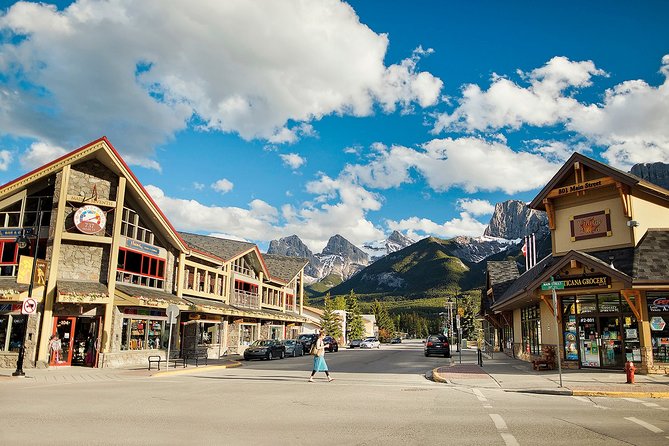
- Live GPS map and auto-playing audio keep you oriented without crowd chaos
- Location-based trivia adds a fun twist without taking over your walk
- Coal-mining era stops make Canmore’s origins feel personal, not abstract
- Mountain-name explanations give context for the views you’ll already want photos of
- Bears sculptures (black vs grizzly) offer a simple, memorable comparison
- Start/stop anywhere means you can fit it around meals, shops, and rest breaks
More Canmore walks and day trips we like just down valley from Canmore
- Canmore Caving Adventure Tour★ 5.0 · 356 reviews
- Canmore Caving Explorer Tour★ 5.0 · 277 reviews
- Canmore: Bow River Scenic Float Tour★ 4.9 · 257 reviews
- Moraine Lake & Louise – Morning or Sunset Tour from Banff/Canmore★ 5.0 · 194 reviews
Cost vs. What You Get for $8.22

At $8.22 per person, this tour is priced like a snack, not a full-day excursion. The value comes from the format: you get a structured route, narration at specific points, and a self-paced way to see a lot of Canmore without paying for a guide or a bus.
It also saves money in a practical way. Most stops are free to view from public areas, and you’re not locked into a single fixed time slot. If you’re already walking around town, this turns “wandering” into a guided loop.
The one caution is admissions. A couple of stops explicitly note that attraction tickets aren’t included (including the Canmore Museum and Geoscience Centre), so budget a bit more if you want every indoor stop.
How the Smartphone Tour Works (No Data Fuss)
This is a download-first experience. You’re told to download on Wi‑Fi before and that the tour doesn’t require signal or data during the walk, which is great for saving roaming hassles and battery stress.
Once you start, a live GPS map shows where you are and where to go next. As you get close to each point, the audio guide plays automatically, so you’re not constantly poking the screen to press play.
You’ll also see optional trivia at each stop. The fun part is that you’re not forced to answer—if you’d rather just listen and keep walking, you can.
A small but important detail: the number of travelers you choose is the number of devices that can download the tour. If you’re traveling with someone who wants their own phone guidance, set it up for the right number of devices.
Where You Start: A Simple Town-Loop Plan
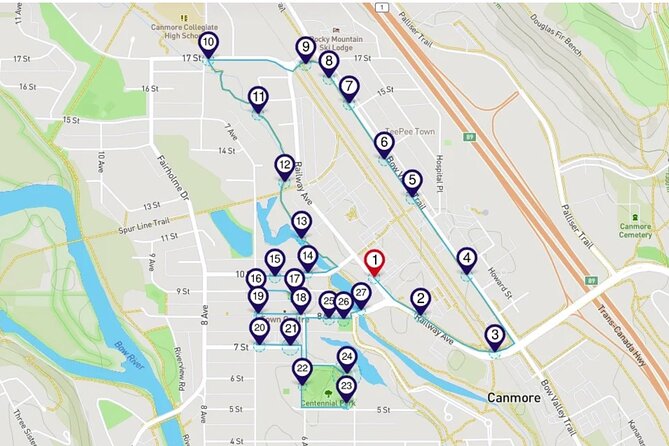
The tour begins at 909A Railway Ave, Canmore and ends back at the same place. That matters because it avoids the awkward “now what?” feeling after a walk.
Timing is flexible. The tour is described as about 1 hour 30 minutes to 2 hours on average, but you’re also told there are no time constraints and you can take as long as you like.
Most stops are quick—many are around three minutes—so if you move steadily you’ll cover a lot. If you pause for photos, read plaques, or duck into shops on Main Street, plan extra time and treat it like an easy afternoon stroll.
Stop-by-Stop: From Three Sisters Gallery to Coal Roots (Stops 1–10)
Wander on with more Banff town walks and ghost tours in Canmore



Stop 1: Three Sisters Gallery
The tour kicks off by guiding you through Three Sisters Gallery and nearby sights, with the promise of both art and history. You’ll also get a 5 km (return) sightseeing tour feel early on, with a route that points out places tied to Canmore’s coal mining days.
This is where the audio guide does its best job at connecting details. Instead of “look at the sculpture,” you’ll hear the story behind the setting—like Policeman’s Creek Boardwalk and the Canmore Miner’s Union Hall area—so your walk feels themed, not random.
Tip: stand still for the opening narration before you start moving. It helps you build mental geography fast.
Stop 2: Bow Valley Trail & Railway Avenue (Canadian Pacific Railway)
Next you cross over to the Bow Valley Trail & Railway Avenue area and learn about the Canadian Pacific Railway and how it shaped Canmore’s development. For a town built around industry and routes, this is a key piece of context.
The value here is that the narration explains the “why” behind what you see. Even if you don’t know railway history, you’ll understand why it mattered where the town grew.
Stop 3: Sidney Street & Bow Valley Trail (British red telephone box)
At the corner, you’ll be pointed to a British-style red telephone box. It sounds like one of those things you photograph and forget—but the tour uses it to teach what makes these phone boxes iconic.
This is a good example of the tour’s style: it takes small details and gives them a reason to matter.
Stop 4: Hospital Place & Bow Valley Trail (black bear sculpture)
Then comes a black bear sculpture, paired with a basic look at black bears in Canmore and the Rocky Mountains. If you’ve ever wondered what you’re actually looking at when wildlife art appears in town, this helps.
Practical note: these sculpture stops are quick, so you’ll keep momentum without feeling “over-programmed.”
Stop 5: Bow Valley Trail & 13 Street (grizzly bear sculpture)
Right after the black bear, you’ll spot a grizzly bear sculpture and get an explanation of the differences. The comparison format makes it memorable, especially if you’re likely to see both bear types in the broader Rockies region.
Stop 6: Bow Valley Trail & 15 Street (mountain names and viewpoints)
This stop is a viewpoint moment. You’ll be guided to look north and learn how several named peaks got their names, including Princess Margaret Mountain, Squaw’s Tit, Mount Charles Stewart, Mount Lady MacDonald, and Mount Grotto.
Even if you skip the naming details, you’ll still benefit from the “what to look at” cue. A good viewpoint stop saves you from guessing which peak is which.
Stop 7: Bow Valley Trail & 17 Street (inukshuk)
At the big inukshuk, you’ll get a short guide to what inukshuks are. This is one of the more respectful cultural stops on the route because it frames the object with meaning, not just design.
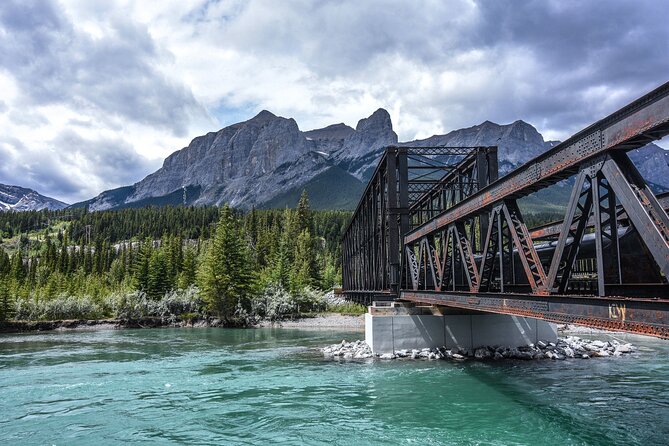
Stop 8: Railway Avenue & Bow Valley Trail (coal mining cars monument)
Here’s the mining anchor: the coal mining cars monument explains mining’s importance in the early days of Canmore. If the earlier railway stop gave you context, this one gives you substance.
This pairing is smart. You walk from “how people and industry moved” to “what the industry actually produced.”
Stop 9: Policeman’s Creek Boardwalk (Bow River, Nordic Centre, events)
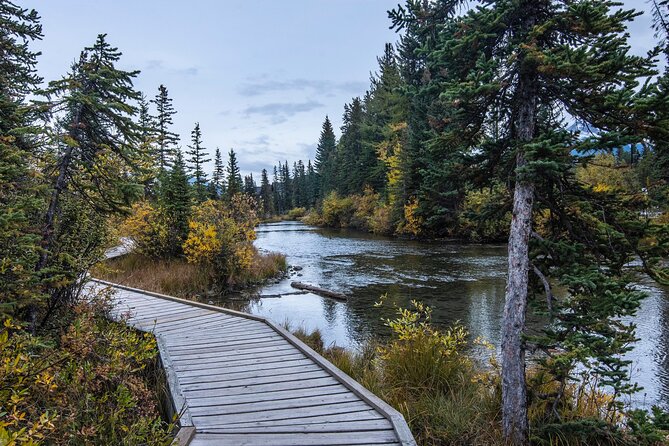
Next, you’ll spend about 10 minutes walking part of the Policeman’s Creek Boardwalk. You’ll also get pointers for the Bow River, the Canmore Nordic Centre, and festivals & events.
This is a nice mid-route reset. The boardwalk lets you shift from street-level stops to something more scenic, without needing a heavy hike.
Stop 10: 10 Street & 6 Avenue (Mount Rundle view)
You finish this first stretch with a lookout toward Mount Rundle. The narration focuses on what’s known about the mountain, and it’s a good “take your breath” stop before the town-center bits begin.
If you’re photographing, try to pause for a full minute. Mountain light changes fast even on bright days.
Stop-by-Stop: Main Street, Museum, Parks, and the Big Head (Stops 11–20)
Stop 11: 719 10 St (Isabelle Dube mural)
At 719 10 St, you’ll see a mural of Isabelle Dube and hear the tragic story behind it. This is one of the tour’s heavier moments, and it gives the walk emotional weight without turning into a long lecture.
I like that the tour doesn’t hide behind only cheerful landmarks. It keeps the town’s story honest.
Stop 12: Canmore Museum and Geoscience Centre (10,000+ artifacts, admission not included)
At the Canmore Museum and Geoscience Centre, you’re pointed to the museum that has over 10,000 artifacts and has welcomed visitors since 1984. The only catch is clear: attraction tickets aren’t included.
So treat this as either a quick external stop for context or as your optional “go inside if you want more” add-on.
Stop 13: Friendship Park (Canmore and Higashikawa)
Then you’ll stroll through Friendship Park, where you learn what Canmore shares with the Japanese city of Higashikawa. This gives the tour a global connection and a reminder that small towns build relationships too.
It’s a quick stop, but it breaks the pattern of local-only history.
Stop 14: 8 Avenue & 6 Street (Main Street shopping and galleries)
At Main Street, the narration turns you into a casual explorer. You’ll be shown the cluster of shops, restaurants, and galleries that make Canmore feel like an actual living town, not just a scenic pass-through.
If you want to grab coffee or browse art, this is where you can build in a detour without messing up your whole route.
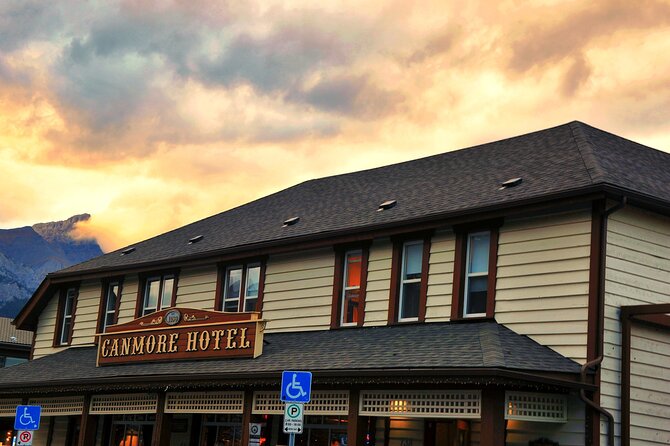
Stop 15: Canmore Inn & Suites (built in 1890 by Count Eugene de Rambouville)
At the Canmore Inn & Suites, you’ll learn it was built in 1890 by Count Eugene de Rambouville. This is the kind of detail that makes older buildings feel connected to people, not just brick.
I like this stop because it’s a reminder that tourism here didn’t start yesterday.
Stop 16: The Canmore Miners’ Union Hall (miners and tensions)
Next, you’ll visit The Canmore Miners’ Union Hall, learning about its importance and the often contentious relationship between the town and miners. This continues the theme from the mining cars and adds the human side.
Even if you only listen for a few minutes, you’ll understand why labor and community dynamics show up in the architecture.
Stop 17: Centennial Park (Three Sisters views + Stan Rogers stage + events)
At Centennial Park, the narration covers three things: views of the Three Sisters Mountains, the Stan Rogers stage, and the annual events and festivals that call the park home.
This stop works even if you don’t know Stan Rogers. It’s one of the best ways to turn sightseeing into “I get why people hang out here.”
Stop 18: Ralph Connor Memorial United Church Canmore (early Alberta church and name mystery)
At the Ralph Connor Memorial United Church, you’ll be pointed to one of the earliest Presbyterian churches built in Alberta and hear the mystery behind its name.
This kind of puzzle-style storytelling makes the building feel like a clue, not a backdrop.
Stop 19: NWMP Barracks (law and order in rougher times)
Then you’ll learn about the NWMP Barracks, and how they helped maintain law and order in Canmore’s rough-and-tumble days. If you want a quick, grounded look at how towns organized themselves during early growth, this is a strong stop.
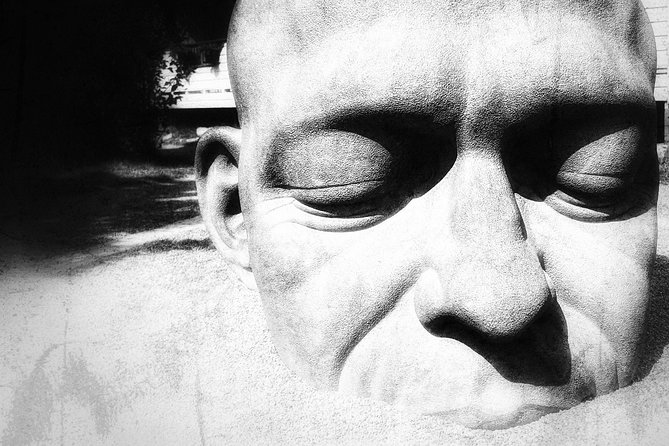
Stop 20: Big Head Sculpture (the name Canmore connection)
The tour ends with the Big Head Sculpture, explaining how it ties into the name Canmore itself. After all the coal, railway, bears, and mountains, this final stop turns the whole walk into a sense of place—how the town’s identity shows up in art and storytelling.
It’s a satisfying bookend because it feels local and a bit quirky in a good way.
Who This Tour Suits Best (and When It Doesn’t)

You’ll likely love this tour if you want a guided walk without paying for a group tour vibe. It’s also ideal if you like short stops—many are only a few minutes long—and you’d rather keep moving than sit through long commentary.
I’d also recommend it if you’re the type who likes to connect landmarks to themes. This route is built around Canmore’s origins (railway and coal), plus a handful of distinctive cultural markers (telephone box, murals, parks, sculptures).
Where it might not fit: if you’re hoping for a deep, long museum-style experience, the tour is time-capped by design and relies on outside admissions for some indoor stops. You can still add the museum, but the audio tour itself is mostly about the walk and public sights.
Also, bring comfortable shoes. Even though many stops are brief, you’re still covering a route through town and along a boardwalk section.
Practical Tips So You Enjoy the Whole Loop
Download on Wi‑Fi first, then keep your phone charged. If your battery is weak, the GPS + audio combo can feel stressful.
Use headphones or keep your speaker volume reasonable. The narration is designed to play when you’re close to each stop, so you want to hear it clearly at each pause point.
Plan a small buffer for photos at the mountain-view stops. The route includes named peaks like Mount Rundle and northern viewpoints, and those are exactly the spots where you’ll want an extra minute.
If you’re traveling with friends, set each person up with a device before you start. The number of travelers you select determines how many devices can download the tour.
Should You Book This Smartphone Audio Tour?
Book it if you want a low-cost way to see a lot of Canmore with a guided feel. For $8.22, the blend of GPS-guided audio, quick thematic stops, and optional trivia makes it a strong value—especially if you already plan to walk around town anyway.
Skip it or adjust expectations if you mainly want paid attractions and indoor time. A couple of highlights require separate tickets, and the tour is built for short, outdoor points.
FAQ
How long is the Sights of Canmore smartphone walking tour?
It’s listed as approximately 1 hour 30 minutes to 2 hours, depending on how long you take at each stop.
Where does the tour start and where does it end?
The tour starts at 909A Railway Ave, Canmore, AB T1W 1P3, Canada, and it ends back at the same meeting point.
Is the tour offered in English?
Yes, it’s offered in English.
Do I need mobile data during the tour?
You’re instructed to download on Wi‑Fi before you go, and the tour indicates no signal or data is required during the experience.
Can I start and stop the tour whenever I want?
Yes. You can start and stop according to your own schedule, and you’re not constrained by a set time limit.
How does the audio guide know when to play?
The tour uses a live GPS map, and the guide commentary automatically plays when you get close to each point of interest.
Is admission included for the museum or other attractions?
No. Tickets for attractions are not included, and the Canmore Museum and Geoscience Centre stop is specifically noted as not included.
Is the trivia game required?
No. Trivia questions are optional at each stop.
Is this tour private for my group?
Yes. It’s described as a private tour/activity, meaning only your group will participate.
What if I need to cancel?
You can cancel up to 24 hours in advance for a full refund.
Are service animals allowed?
Yes, service animals are allowed.
More Town Walks & Ghost Tours in Canmore




More Canmore Walks & Day Trips near Canmore




More Tour Reviews in Canmore
Still scrolling? A few other Canmore adventures worth a spot on the itinerary





Canmore Tours & Day Trips, compared.
 ★ 4.9Banff/Canmore: Moraine Lake 1.5h & Lake Louise Half-Day TourFrom $45619 reviews
 ★ 5.0Canmore Caving Adventure TourFrom $149356 reviews
 ★ 4.9Banff/Canmore: Moraine Lake w/ Lake Louise OptionFrom $87292 reviews
 ★ 5.0Canmore Caving Explorer TourFrom $111277 reviews
 ★ 4.9Canmore: Bow River Scenic Float TourFrom $43257 reviews
 ★ 5.0Moraine Lake & Louise – Morning or Sunset Tour from Banff/CanmoreFrom $111194 reviews
 ★ 5.0Moraine Lake Sunrise(2.5hrs)&Lake Louise(2hrs) from Canmore/BanffFrom $138168 reviews
 ★ 4.9From Canmore/Banff: Moraine Lake Sunrise & Lake Louise TourFrom $142163 reviews
Browse the lists this tour appears in